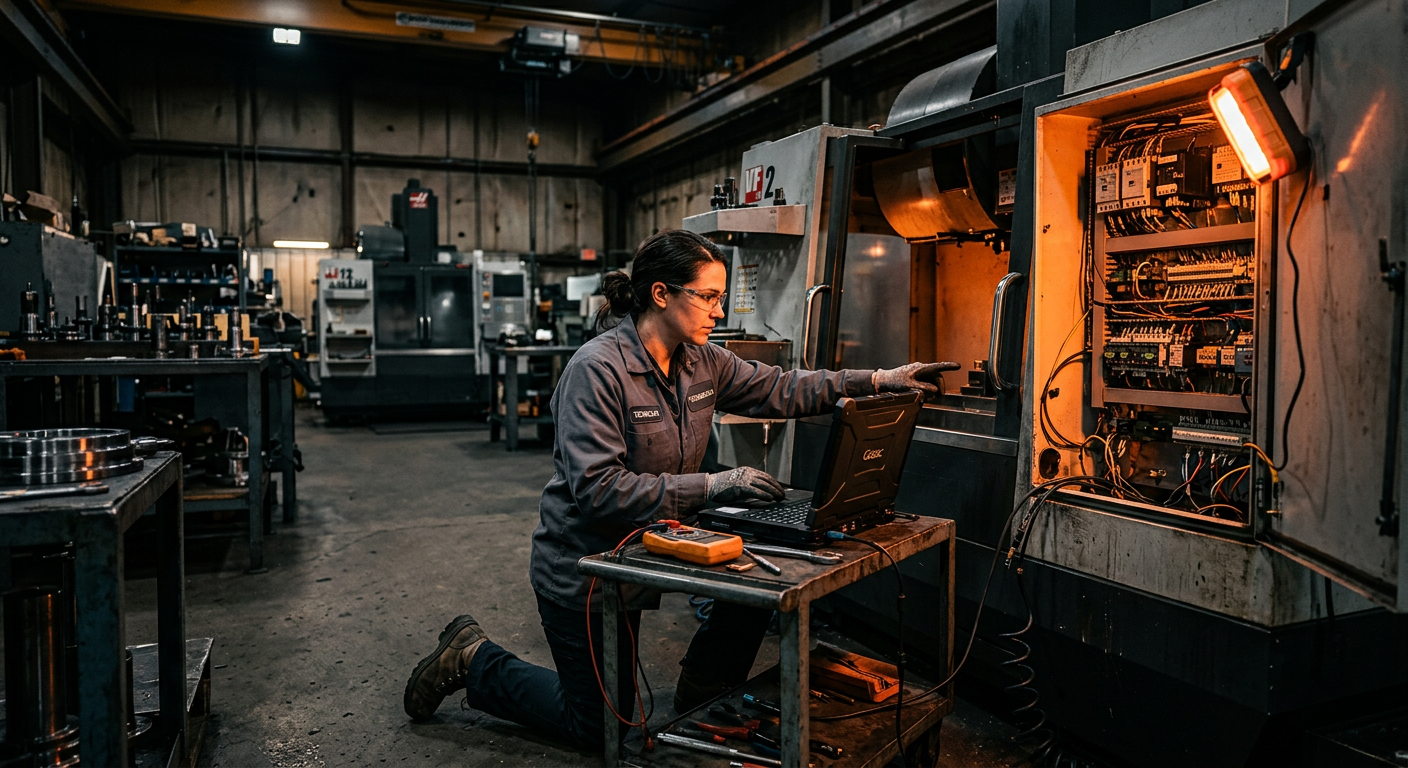
CNC calibration is one of those maintenance tasks that's easy to postpone — until you start seeing out-of-tolerance parts or failed inspections. For New England manufacturers working in aerospace, medical devices, and defense sectors, proper calibration isn't optional; it's a requirement for maintaining certifications and customer confidence.
CNC machine calibration frequency: Most VMCs and turning centers should be calibrated annually under light use, semi-annually under standard production, and quarterly under heavy or precision use. Calibrate immediately after any crash, machine move, major repair, or when parts start drifting out of tolerance without a clear cause.
But how often should you calibrate your CNC machine? The answer depends on several factors unique to your operation.
Why CNC Calibration Matters
Every CNC machine drifts over time. Thermal expansion, mechanical wear, and environmental factors all contribute to gradual changes in positioning accuracy. Without regular CNC calibration:
- Parts may slowly drift out of tolerance
- Scrap rates increase
- Tool life decreases due to improper cuts
- Surface finish quality degrades
- You risk failing customer audits or quality certifications
Recommended CNC Calibration Frequencies
Based on our experience servicing hundreds of CNC machines across New England, here are general guidelines:
| Machine Type | Light Use | Standard Use | Heavy/Precision Use |
|---|---|---|---|
| VMC (Vertical Machining Center) | Annually | Semi-annually | Quarterly |
| HMC (Horizontal Machining Center) | Annually | Semi-annually | Quarterly |
| CNC Lathe/Turning Center | Annually | Semi-annually | Quarterly |
| 5-Axis Machines | Semi-annually | Quarterly | Monthly verification |
| Swiss-Type Lathes | Semi-annually | Quarterly | Monthly |
Factors That Affect CNC Calibration Frequency
1. Tolerance Requirements
If you're holding tolerances of ±0.0005" or tighter, you need more frequent calibration than a shop working to ±0.005". Many aerospace and medical device manufacturers in the Boston area calibrate quarterly or even monthly for their most critical machines.
2. Machine Age and Condition
Older machines and those with worn components drift faster. If your machine is more than 10 years old or has significant hours, consider increasing calibration frequency. Pairing calibration with CNC repair when needed keeps machines at peak performance.
3. Environmental Conditions in New England
New England's dramatic temperature swings affect machine geometry. A machine that sits in a non-climate-controlled shop in Vermont or Maine will need more frequent calibration than one in a temperature-controlled facility.
4. Material and Cutting Conditions
Heavy cuts in hard materials cause more wear and thermal stress. Shops doing aggressive roughing operations should calibrate more frequently than those doing light finishing work.
5. Machine Utilization
A machine running 24/7 needs more frequent calibration than one running a single shift. High-utilization machines in Connecticut's defense manufacturing corridor often require quarterly or monthly checks.
Types of CNC Calibration Checks
Positioning Accuracy (Linear)
Using a laser interferometer, we measure actual vs. commanded position across each axis. This identifies:
- Lead screw pitch errors
- Backlash
- Servo tuning issues
- Scale calibration errors
Geometry and Squareness
Checking that axes are perpendicular to each other. Out-of-square machines produce parts with angular errors.
Rotary Axis Calibration
For 4th and 5th axis machines, rotary axes must be calibrated for:
- Angular positioning accuracy
- Centerline location
- Perpendicularity to linear axes
Ball Bar Testing
A quick test that reveals servo tuning issues, backlash, and geometric errors by tracing a circular path.
Signs You Need Immediate CNC Calibration
Don't wait for your scheduled calibration if you notice:
- Parts consistently out of tolerance in one direction
- Increasing scrap rates without obvious cause
- Visible stepping or lines in machined surfaces
- Different results from duplicate programs
- Circular interpolation producing ellipses instead of circles
- After a crash or collision
- After moving the machine
- After major CNC repairs or component replacement
Documentation and Compliance
For ISO, AS9100, or ITAR-compliant shops, calibration records are essential. Your documentation should include:
- Date and time of calibration
- Equipment used (with its own calibration certificates)
- Before and after measurements
- Adjustments made
- Technician identification
- Next calibration due date
CNC Calibration Cost vs. Risk Analysis
Many shops delay calibration to save money, but consider the costs of not calibrating:
- Scrap: A $50 part scrapped 10 times = $500
- Rework: Hours of machine time and labor
- Customer returns: Shipping, inspection, replacement costs
- Lost customers: Quality issues damage relationships
- Failed audits: Risk losing certifications
A professional calibration typically costs $500–$1,500 depending on machine complexity. Compare that to the cost of even a few scrapped parts or one lost customer.
For context on how calibration fits into the broader maintenance picture, see our CNC preventive maintenance guide with recommended scheduling by task type.
Need CNC Repair in New England?
Maz CNC provides fast, on-site CNC repair across Massachusetts, Connecticut, Rhode Island, New Hampshire, Vermont, and Maine. Available 24/7 for emergencies.
Get a Free Quote